Bill 148 and Your Clinic’s EMR: What Ontario’s Proposed Health Record Changes Could Mean for Family Practices
On November 16, 2026, Ontario introduced Bill 148, the Protect Ontario Families and Communities Act, 2026. Most of the headlines have been about child welfare and intimate image abuse. But Schedule 16 of the bill amends the Personal Health Information Protection Act, 2004 (PHIPA), Ontario’s health privacy law, and it touches something every family practice deals with: how patient information gets into the provincial electronic health record (EHR).
Nothing changes today. Bill 148 is still proposed legislation, and even if it passes, Schedule 16 would only come into force on a date the province sets later. Here is what it proposes, what the government says it would do, and the admin questions we think clinic owners should keep an eye on.
The problem the province describes
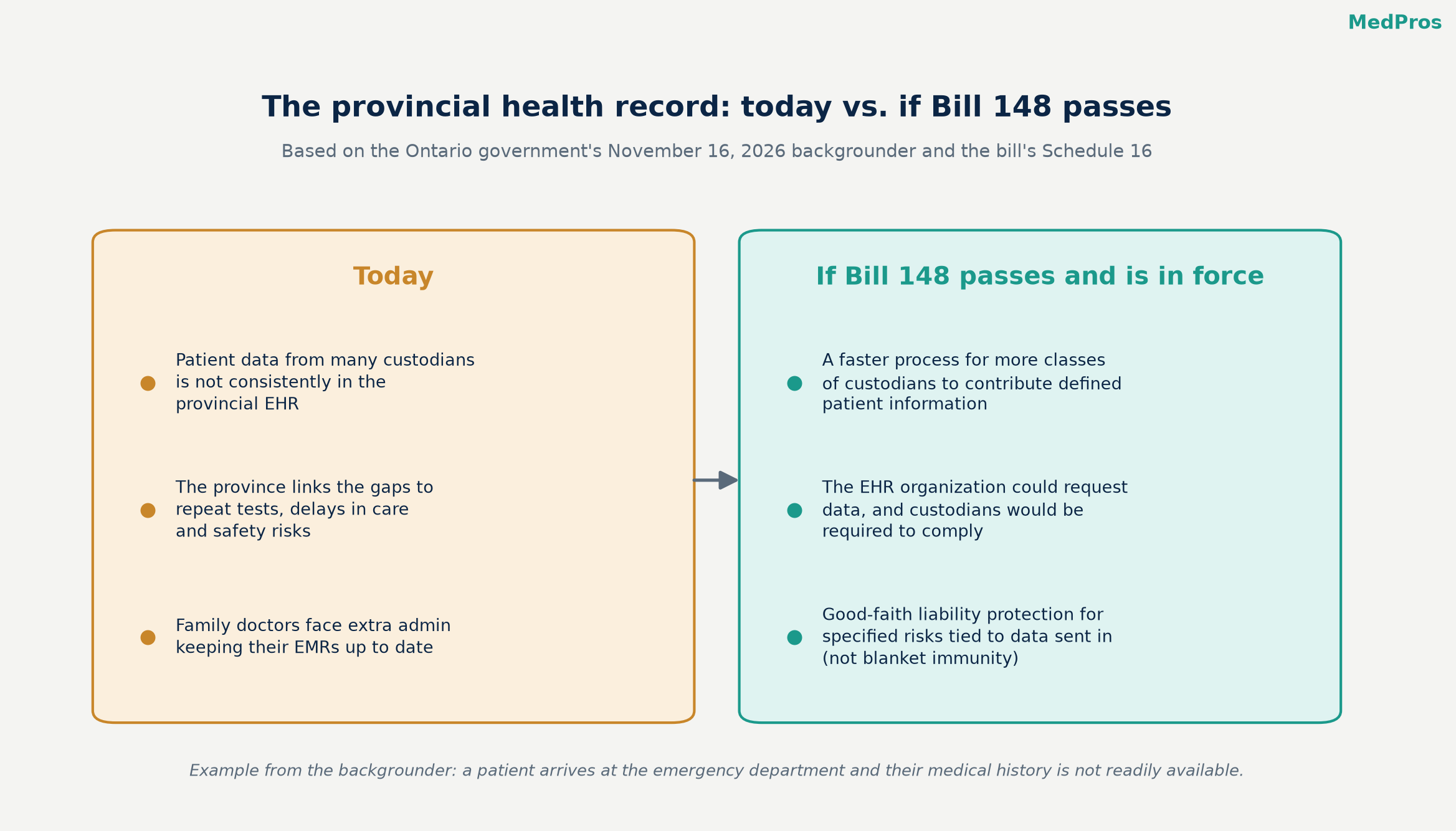
The government’s backgrounder is direct about the current state. Patient data from many health information custodians (the individuals and organizations that hold patient records under PHIPA) is not consistently available in the provincial EHR. The province says that when information is missing, it leads to safety risks, unnecessary repeat tests and delays in care. Its example is a patient who ends up in the emergency department without their medical history readily available.
The backgrounder also names a problem most family doctors will recognize. Gaps in the record make it harder to keep electronic medical records (EMRs) up to date, which adds administrative burden and takes time away from patients.
What Bill 148 would change
In the government’s words, the PHIPA amendments “would establish a faster process for additional classes of Health Information Custodians to contribute defined patient information to the provincial Electronic Health Record.”
The bill itself is more specific about how that would work. Based on the explanatory note to Schedule 16:
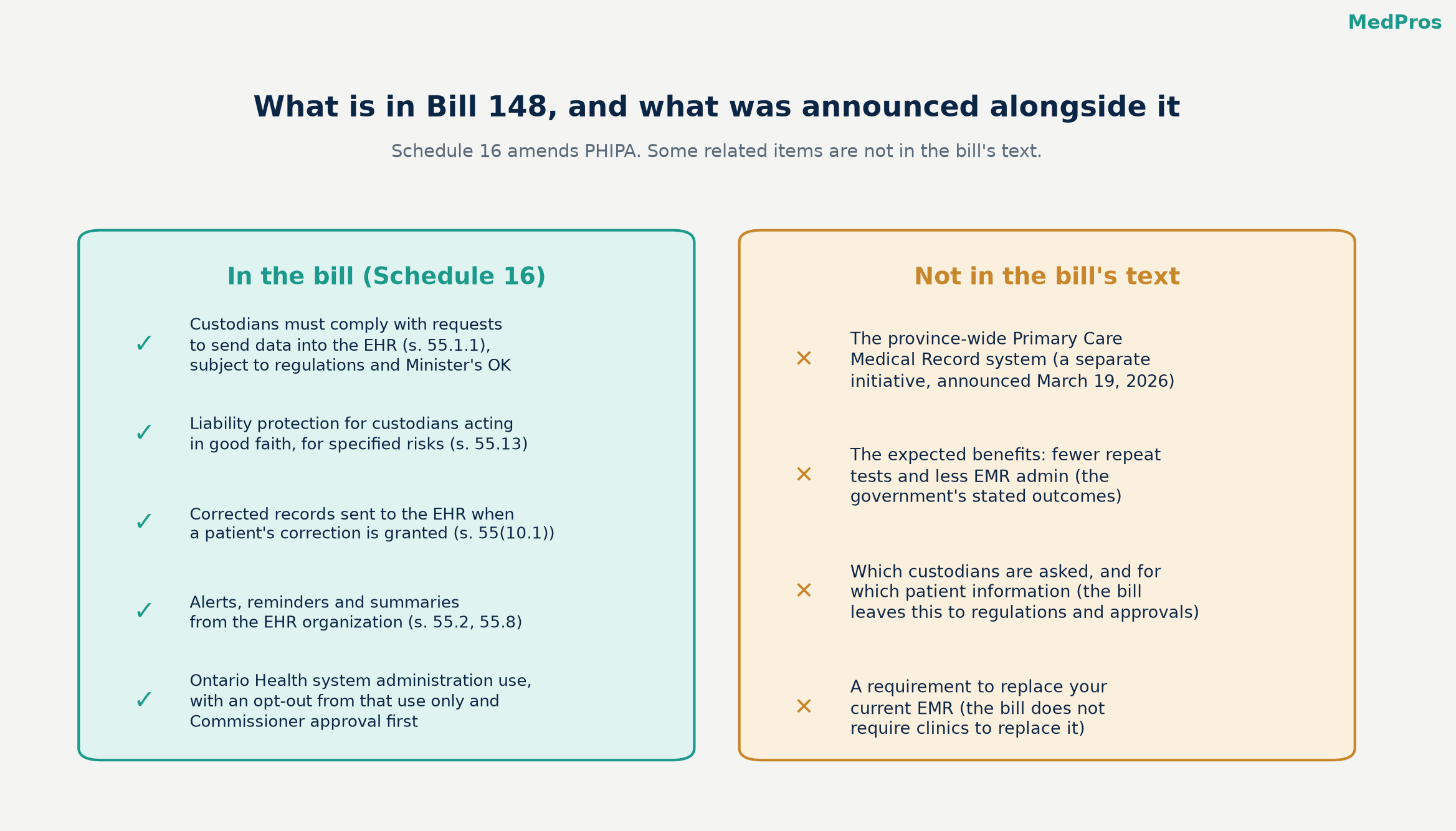
- Requests to send data. A new section 55.1.1 would let the organization that runs the provincial EHR (the “prescribed organization” under PHIPA) request that custodians transmit personal health information into the EHR, subject to the regulations and the Minister’s approval. Custodians would be required to comply.
- Liability protection. The protection from liability in section 55.13 would be expanded to custodians acting in good faith when they transmit personal health information into the EHR. It covers specified risks associated with the information they provide. It is not blanket immunity from privacy-related liability.
- Patient corrections. Under a proposed new subsection 55(10.1), when a custodian grants a patient’s request to correct a record contained in the provincial EHR, the custodian must submit the corrected record to the EHR. For clinics, that could add a step to how correction requests are logged, made in the EMR and sent on.
- Summaries and alerts. The EHR organization could create summaries of personal health information and other supports. A new section 55.8 would let it send notifications, reminders and alerts to custodians, even where a patient has a consent directive, as long as they do not reveal the information that directive covers.
- Health system administration. PHIPA’s purposes would expand to include health system administration. The backgrounder says Ontario Health’s data roles would move into one framework. Individuals could opt out of having their EHR information provided to Ontario Health for health system administration, subject to the bill’s requirements and limits. This is not a general opt-out from contributing patient information to the provincial EHR. Under the bill, collection by means of the EHR for this purpose could not start until the Information and Privacy Commissioner of Ontario approves the practices and procedures.
The schedule also makes Indigenous midwives who provide traditional midwifery services health information custodians, and adds related regulation-making powers.
What is in the bill, and what is not
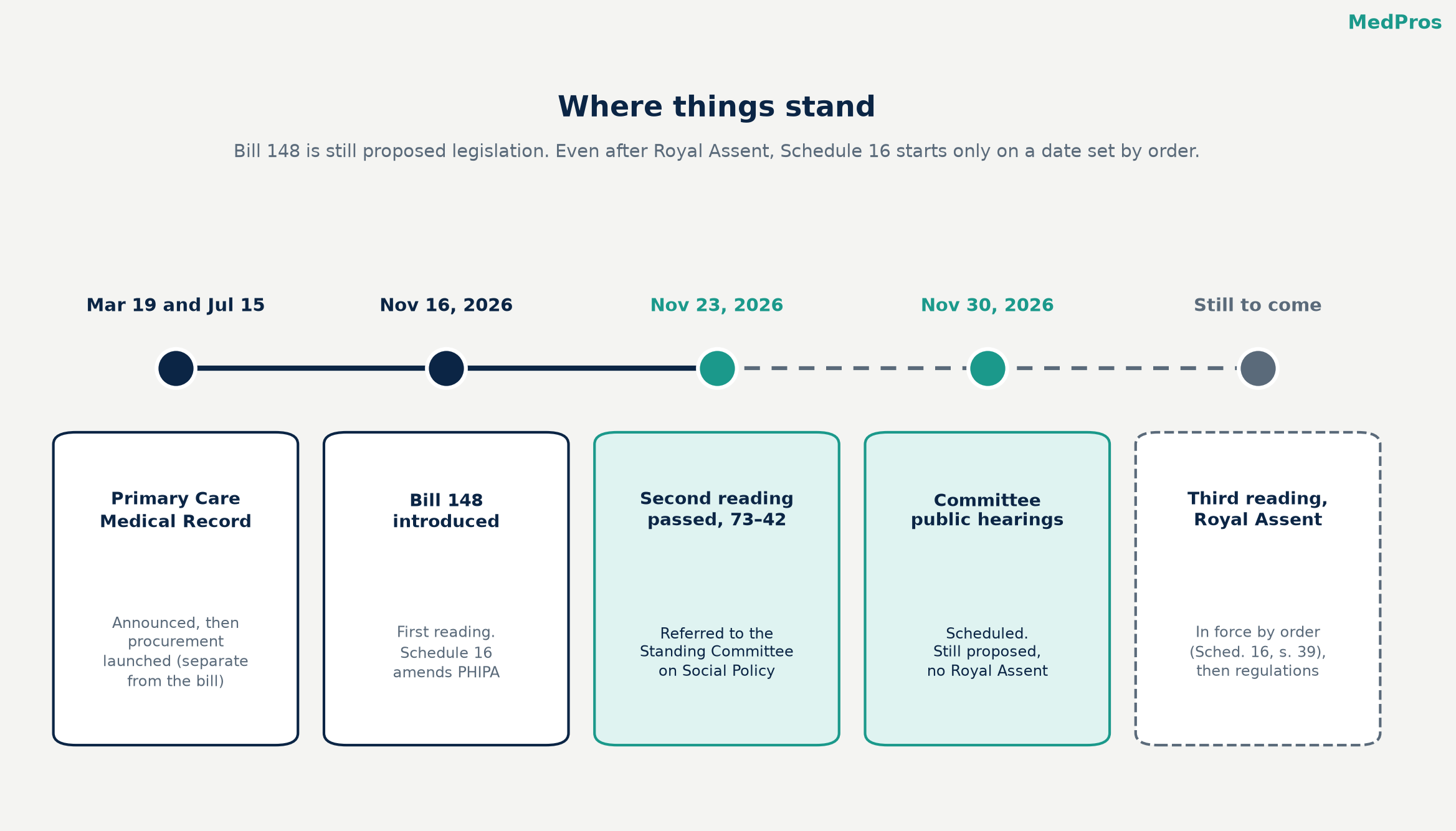
One point is worth being clear on. The backgrounder says these measures “would complement the proposed province-wide Primary Care Medical Record system.” That system is not part of Bill 148. It is a separate initiative that Ontario announced on March 19, 2026, followed by a procurement launched on July 15, 2026, with OntarioMD involved in development and implementation. The province has said family physicians will be able to choose whether to move to it. Bill 148 does not require clinics to replace their existing EMR systems.
The benefits the government describes, fewer repeat tests and less EMR admin, are its stated goals rather than rules in the bill. And the bill does not name which custodians would be asked first or exactly which patient information. Those details would come through regulations and approvals.
Where Bill 148 stands
Bill 148 passed first reading on November 16, 2026, and second reading on November 23, 2026, by a vote of 73–42. It has been referred to the Standing Committee on Social Policy, with public hearings scheduled for November 30, 2026. It remains proposed legislation and has not received Royal Assent. You can follow its progress on the Legislative Assembly’s current bills page.
It helps to keep three steps apart. Passing means committee review, third reading and Royal Assent. Coming into force is separate: under section 39 of Schedule 16, the PHIPA changes would not take effect automatically on Royal Assent, but on a date set by order of the Lieutenant Governor in Council. Practical implementation comes after that, through regulations, the Minister’s approval of requests and the Commissioner’s approval for health system administration.
Admin questions to watch
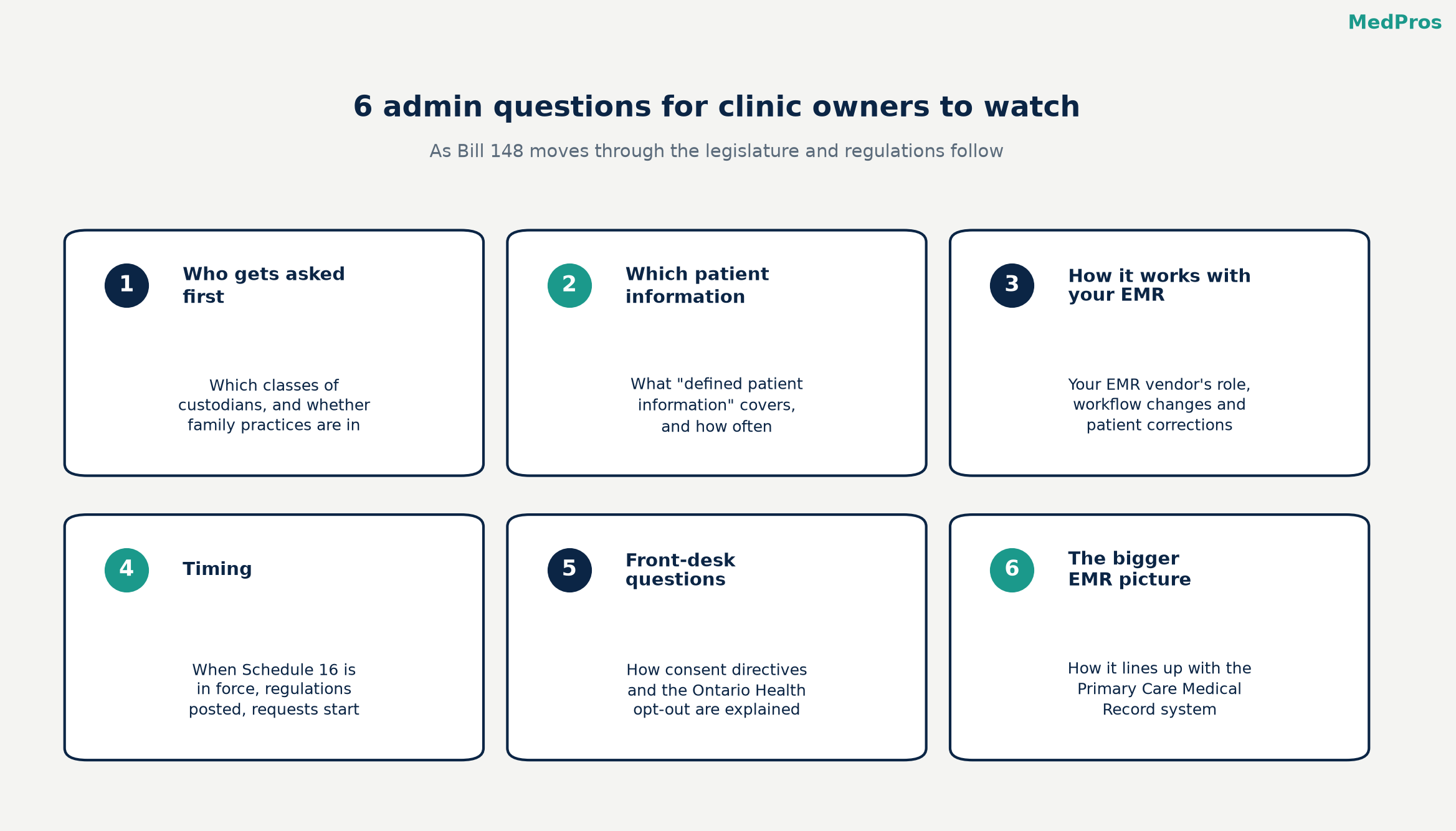
If the bill passes, the practical effect on your clinic will depend on the details that follow. These are the questions we are watching for the clinics we work with:
- Who gets asked first. Which classes of custodians receive requests to contribute, and whether community family practices are among them.
- Which patient information. What “defined patient information” covers, and how often it would be requested.
- How it works with your EMR. Whether data would flow through your current EMR vendor, and what setup or workflow changes, including for patient corrections, that could mean for your team.
- Timing. When Schedule 16 is brought into force, when the regulations are posted, and when approvals and any requests would start.
- Front-desk questions. How consent directives and the Ontario Health opt-out will be explained to patients who ask.
- The bigger EMR picture. How these changes line up with the Primary Care Medical Record system, especially if you are weighing an EMR change or planning a new clinic.
None of this calls for action today. It is a reason to follow the bill and the regulations that come after it, and to make sure whoever manages your EMR and front desk knows it is coming.
We will share the details as the province publishes them.
Running a family practice in Ontario?
MedPros works with more than 20 clinics across Ontario on clinic setup, EMR setup and day-to-day operations. If you want to talk through how changes like this fit into your plans, email info@medpros.ca or reach us through our contact page.
Want our monthly MedPros Insider newsletter? Email info@medpros.ca and ask to be added.
Source: Government of Ontario, news release and backgrounder (November 16, 2026); Legislative Assembly of Ontario, Bill 148 and Schedule 16 and legislative status; Primary Care Medical Record system releases (March 19, 2026 and July 15, 2026).