CPSO’s New Pathway for Specialists from Approved Jurisdictions, Without Royal College Certification
CPSO has approved a new registration policy for specialist physicians who were trained and certified in an approved international jurisdiction. Under the policy, those physicians may be issued a provisional certificate of registration without certification from the Royal College of Physicians and Surgeons of Canada (RCPSC).
CPSO published the change in its August 2026 Dialogue. For practices recruiting specialists or expanding a clinic in Ontario, the useful part is the scope: it is not automatic licensure, but it does open a defined route for a defined group of specialists.
This is the second recent CPSO change that lowers a registration barrier. In October, CPSO removed the MCCQE and LMCC requirement for physicians who already hold RCPSC or College of Family Physicians of Canada (CFPC) certification. That earlier post is part of the same series: CPSO no longer requires MCCQE or LMCC for certified physicians.
What changed
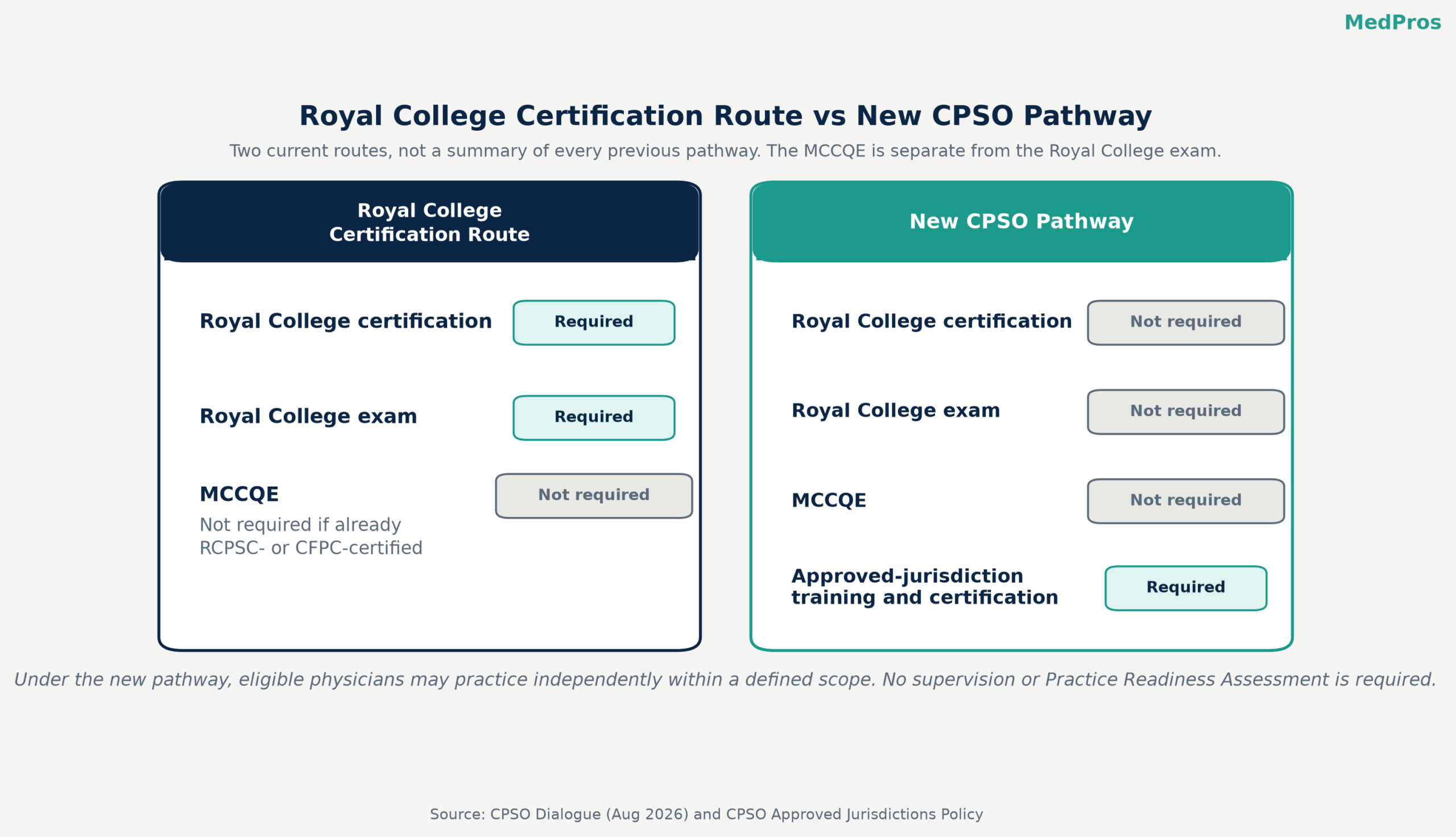
The new policy lets CPSO issue a provisional certificate without RCPSC certification, and without the Royal College certification exam. The MCCQE is a separate exam. Eligible physicians trained in an approved jurisdiction also do not have to challenge the MCCQE.
CPSO’s FAQs are direct on points that often get misunderstood. A Practice Readiness Assessment or supervised assessment is not required. The policy does not require supervision. Physicians issued a provisional certificate under this policy are permitted to practice independently within their defined scope of practice.
“Provisional” here does not mean the physician cannot practice on their own. CPSO says the provisional class is for physicians whose certificates only have limitations related to registration pathways, such as scope of practice. A certificate issued under this policy has no fixed expiry date, but the physician must complete CPSO’s annual registration renewal.
Who qualifies
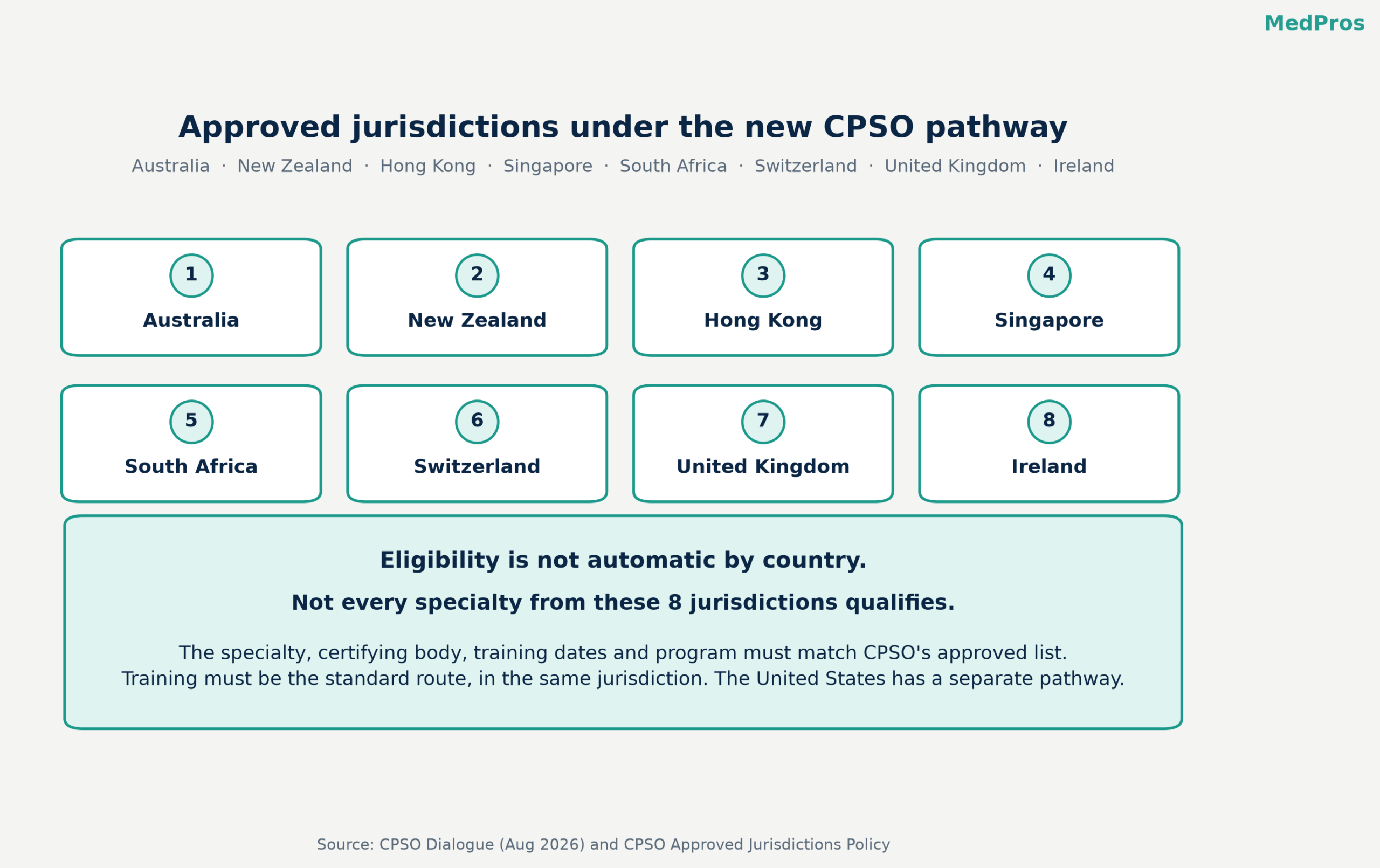
The policy uses a list of international jurisdictions maintained by the Royal College, in which medical training in certain specialties has been deemed substantially equivalent to RCPSC specialty training requirements. CPSO’s Dialogue article lists those jurisdictions as Australia, New Zealand, Hong Kong, Singapore, South Africa, Switzerland, the United Kingdom, and Ireland.
Eligibility is not automatic by country. Not every specialty from these eight jurisdictions qualifies. The candidate’s specialty, certifying body, training dates and program must match CPSO’s approved list. Dates of acceptable training vary by specialty or program, and the full table lives in the policy. Physicians trained and certified in the United States are pointed to a separate CPSO pathway, not this one.
To be eligible, the policy requires:
- A medical degree from an acceptable school.
- Successful completion of specialty training, and certification as a specialist by a certifying body in an approved jurisdiction.
- That the organization which recognized the applicant as a medical specialist did so using standards substantially equivalent to those of the RCPSC.
The physician must also satisfy the non-exemptible requirements set out in Section 2(1) of Ontario Regulation 865/93.
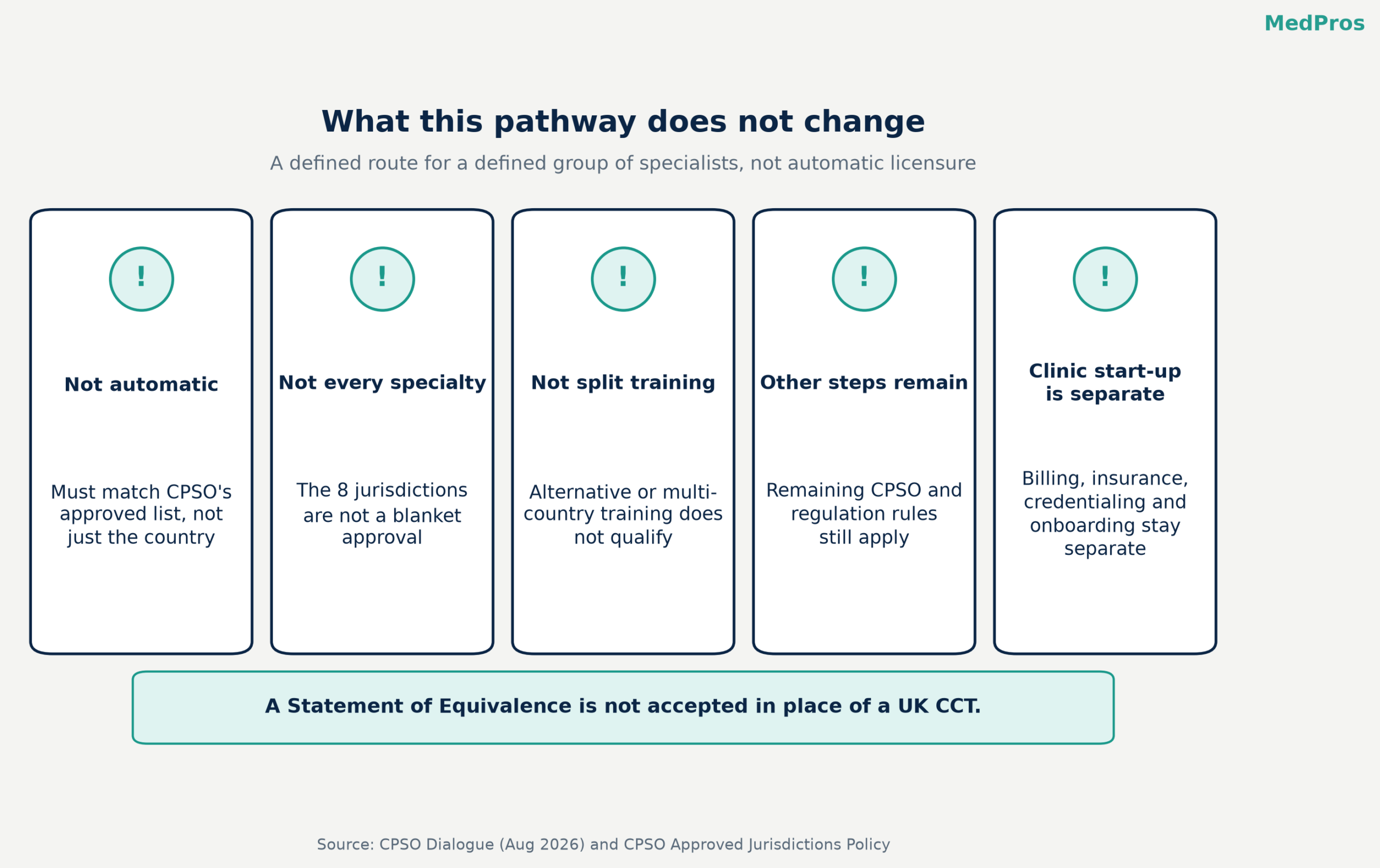
CPSO’s FAQs add conditions that matter in recruitment conversations. All required training for the primary specialty and, if applicable, the subspecialty must have been completed through the standard training route within the same approved jurisdiction, and that specialty must be formally listed on the RCPSC approved-jurisdiction list. Training completed through an alternative pathway, in multiple countries, or outside the approved jurisdiction does not qualify. For physicians trained in the United Kingdom, a Statement of Equivalence to a Certificate of Completion of Training (CCT) is not an acceptable alternative to a CCT.
What this is not
This is a new pathway, not a shortcut past registration. If the jurisdiction or certification is not in the policy appendix, the physician is not eligible under this policy and may need to consider other registration options. CPSO still assesses the application, and the remaining requirements in the regulation still apply.
What this means for specialist recruitment and clinic expansion
For a practice recruiting specialists or expanding a clinic in Ontario, this pathway can matter when a candidate was trained and certified in a listed specialty in an approved jurisdiction, and has not obtained Royal College certification.
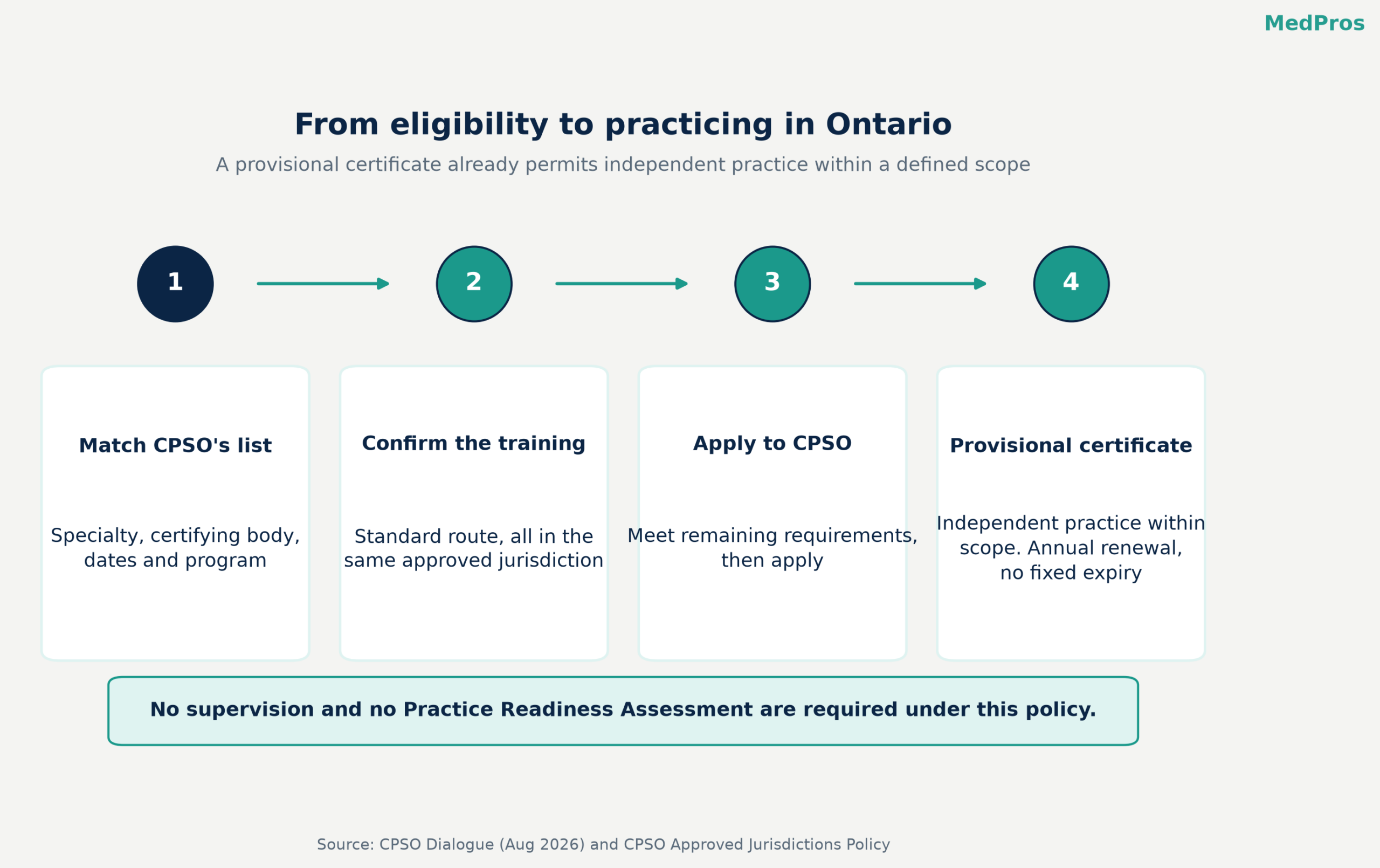
Eligible physicians may practice independently within their approved scope, without the supervision or Practice Readiness Assessment that some other pathways require. CPSO registration, OHIP billing, insurance, hospital or clinic credentialing, and onboarding into the practice remain separate steps. Confirm the specialty, certifying body, dates and program against CPSO’s table, and do not treat registration as finished until the College confirms it.
How MedPros can help
MedPros supports clinic setup and operations for more than 20 clinics across Ontario. We can help with specialist clinic setup, medical office construction, clinic management, physician recruitment coordination and onboarding into the practice. We do not decide CPSO eligibility, and we do not give immigration or legal advice. Registration questions belong with the College.
If you are planning for a specialist to join a new or expanding practice, email info@medpros.ca.
Want our monthly MedPros Insider newsletter, or first word on new clinic, location and pharmacy opportunities? Email info@medpros.ca and ask to be added.
Sources
- CPSO Dialogue: New Pathway for Specialists from Approved Jurisdictions Without Royal College Certification (August 2026)
- CPSO: Provisional Certificate of Registration for Physicians Certified in Approved Jurisdictions
- CPSO: Approved Jurisdiction Policy FAQs
- Related reading: CPSO no longer requires MCCQE or LMCC for certified physicians
This is general information for Ontario clinics and physicians, not legal, registration, immigration or medical advice. Confirm current CPSO registration requirements and your own application pathway directly with the College before relying on this summary.