CPSO No Longer Requires MCCQE or LMCC for RCPSC- or CFPC-Certified Physicians
CPSO has approved a new registration policy that removes a long-standing exam barrier for many physicians who already hold Canadian specialty or family medicine certification.
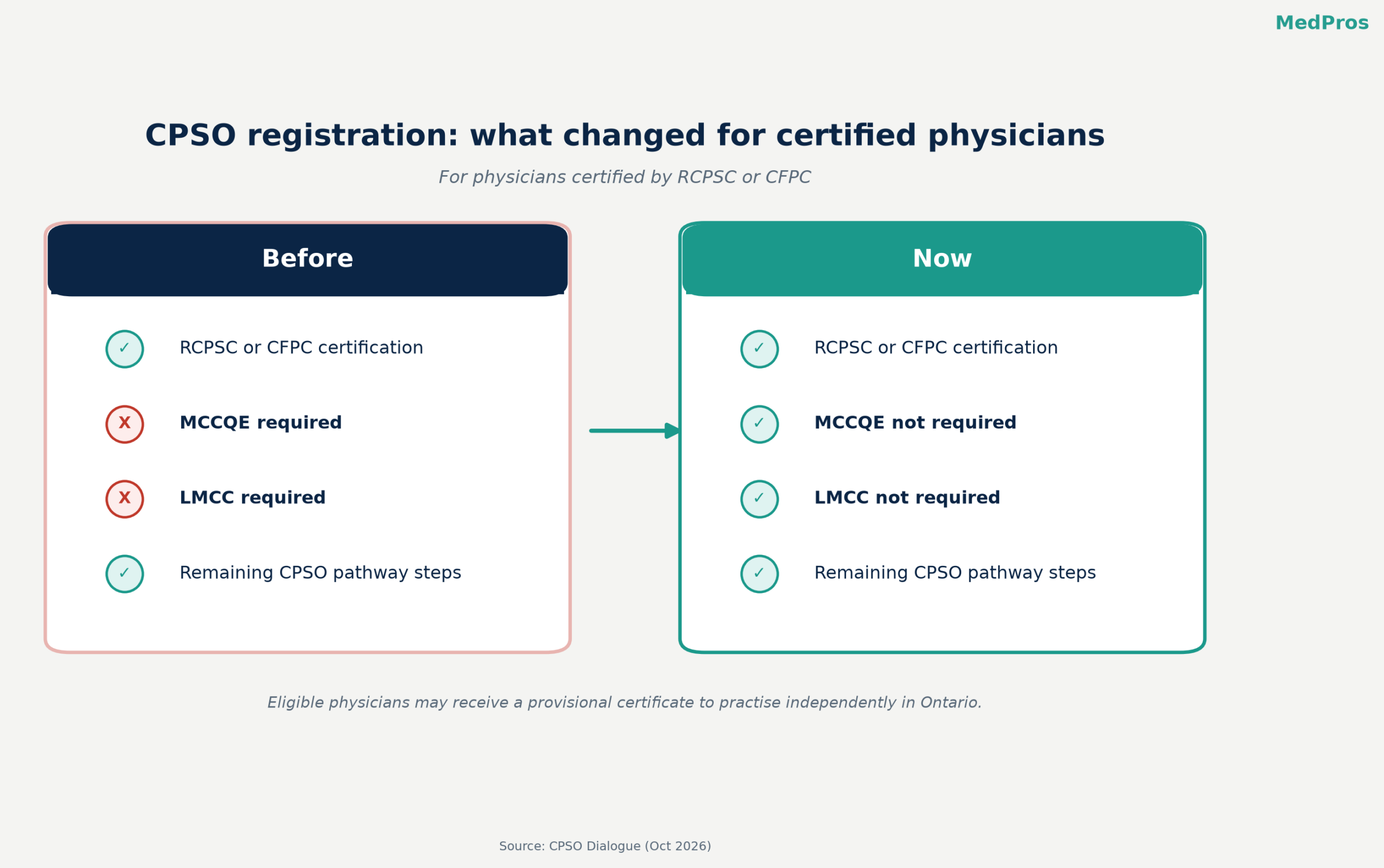
Under the policy, Canadian- and internationally-trained physicians who are certified by the Royal College of Physicians and Surgeons of Canada (RCPSC) or the College of Family Physicians of Canada (CFPC) are no longer required to challenge the Medical Council of Canada Qualifying Examination (MCCQE) or hold the Licentiate of the Medical Council of Canada (LMCC) in order to register with CPSO.
For practices that are actively recruiting physicians, that is an operational change worth understanding. It does not replace the rest of CPSO’s registration pathway. It does remove one requirement that often sat between a certified physician and joining a practice in Ontario.
What changed
CPSO’s October 2026 Dialogue article explains the policy in plain terms. Eligible physicians may be granted a provisional certificate of registration to practise independently in Ontario without completing the MCCQE or holding the LMCC.
The MCCQE (previously MCCQE Part 1; Part 2 was discontinued in 2021) is designed to assess medical knowledge and clinical decision-making at the end of medical school. CPSO’s stated rationale is that this is not an appropriate registration requirement for physicians who have already demonstrated competence through Canadian certification and, for mid-career physicians, prior practice experience.
In short: if the physician already holds RCPSC or CFPC certification, CPSO will no longer insist on the MCCQE or LMCC as part of registration under this policy.
Who this helps
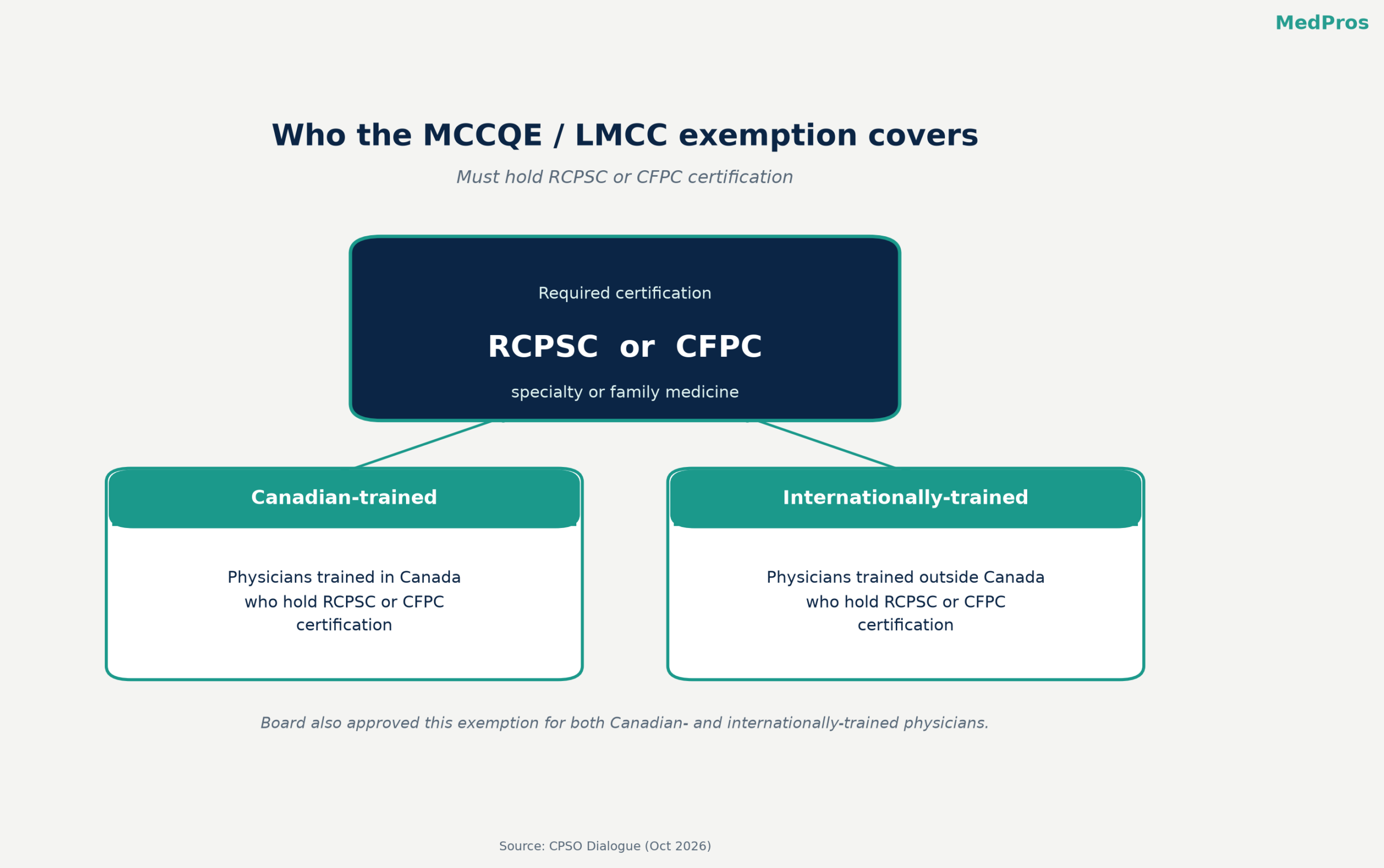
The change covers both Canadian-trained and internationally-trained physicians, provided they hold the relevant RCPSC or CFPC certification.
That matters for a few common recruitment situations:
- A Canadian-trained specialist or family physician who completed certification but never sat, or never finished, the MCCQE pathway that older rules assumed.
- An internationally-trained physician who has already secured RCPSC or CFPC certification and is looking at Ontario registration without repeating an end-of-medical-school exam.
- Mid-career physicians moving into Ontario practice who already have Canadian certification and prior practice experience.
It is especially relevant for practices recruiting physicians from outside Ontario, or from training and practice backgrounds where the MCCQE was a separate, time-consuming step after certification was already in hand.
What did not change
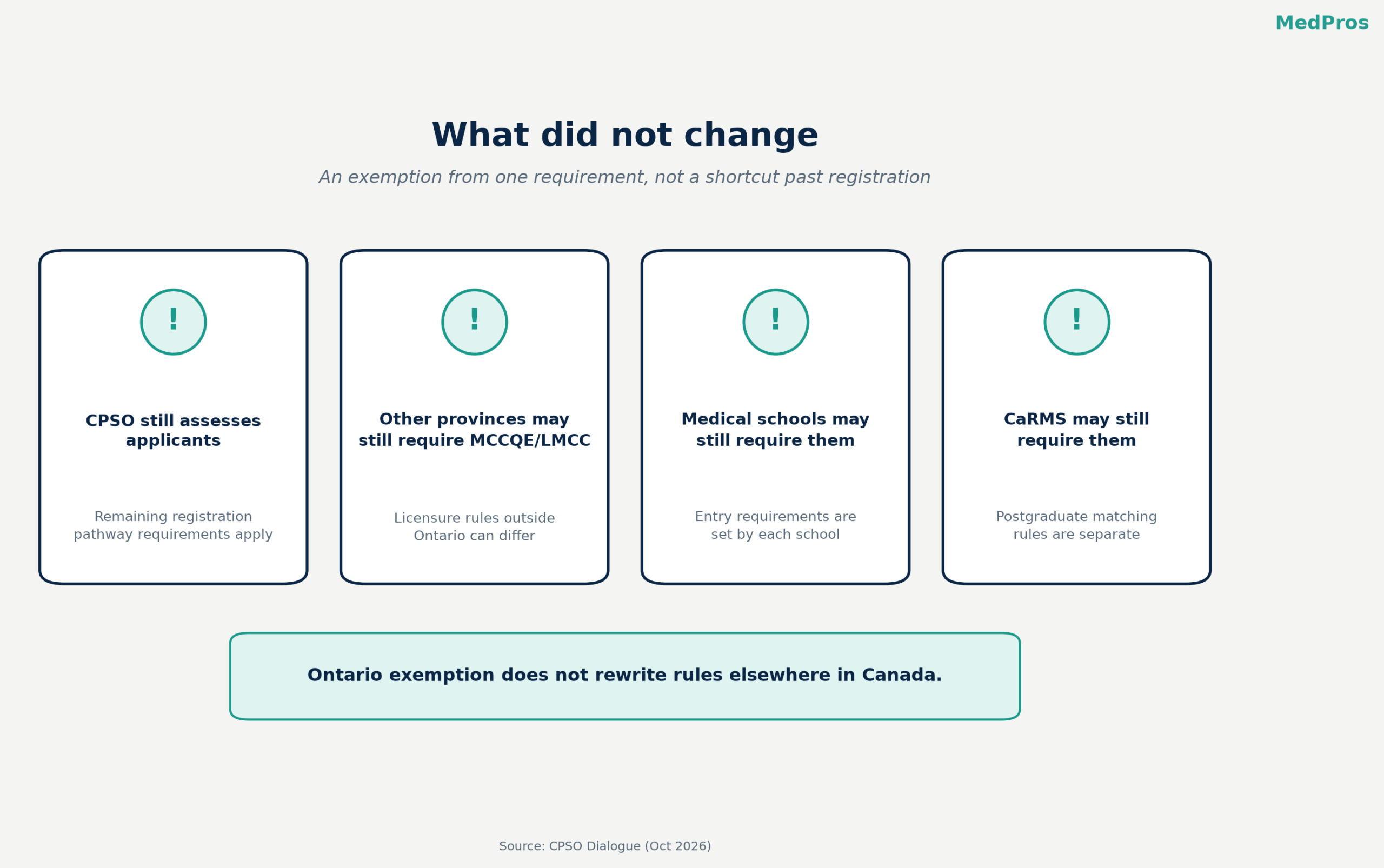
This is an exemption from one requirement, not a shortcut past registration.
CPSO still assesses applicants under its registration framework. Holding RCPSC or CFPC certification and being excused from the MCCQE or LMCC does not, by itself, mean a licence is automatic. The physician still has to qualify under an applicable registration pathway and meet the remaining requirements CPSO applies to that pathway.
CPSO also flags an important geographic caveat. Other Canadian provinces and territories may still require the MCCQE or LMCC for their own licensure. Medical schools, and the Canadian Resident Matching Service (CaRMS) for entry into postgraduate training programs, may still require these qualifications as well. A physician cleared of the Ontario exam requirement for CPSO registration can still meet different rules elsewhere.
For clinic owners, the practical takeaway is narrow and useful: when a candidate already has RCPSC or CFPC certification, Ontario registration no longer hinges on the MCCQE or LMCC under this policy. Confirm the rest of their pathway with CPSO, and do not assume the same rules apply if they also need a licence in another province.
Why practices recruiting physicians should care
Physician recruitment in Ontario is still constrained by how long it takes a qualified doctor to become fully able to practise. Anything that removes a redundant step shortens that path for some candidates.
If your practice is building a family medicine group, adding a specialist session, or opening a new location, candidates who already hold RCPSC or CFPC certification may now face one fewer exam barrier in Ontario. That can matter for:
- candidates already practising elsewhere in Canada who are considering joining a practice here
- internationally-trained physicians who completed Canadian certification and were waiting on MCCQE or LMCC paperwork
- practices comparing start dates, because exam scheduling and result timelines are no longer part of the critical path for this group
It does not change credentialing inside your clinic, hospital privileges, insurance, or how OHIP billing numbers are obtained. Those remain separate processes. It also does not change who is clinically ready to see patients. It changes one CPSO registration requirement for a defined group of certified physicians.
A practical checklist for clinic owners
When a candidate mentions this policy, keep the conversation concrete:
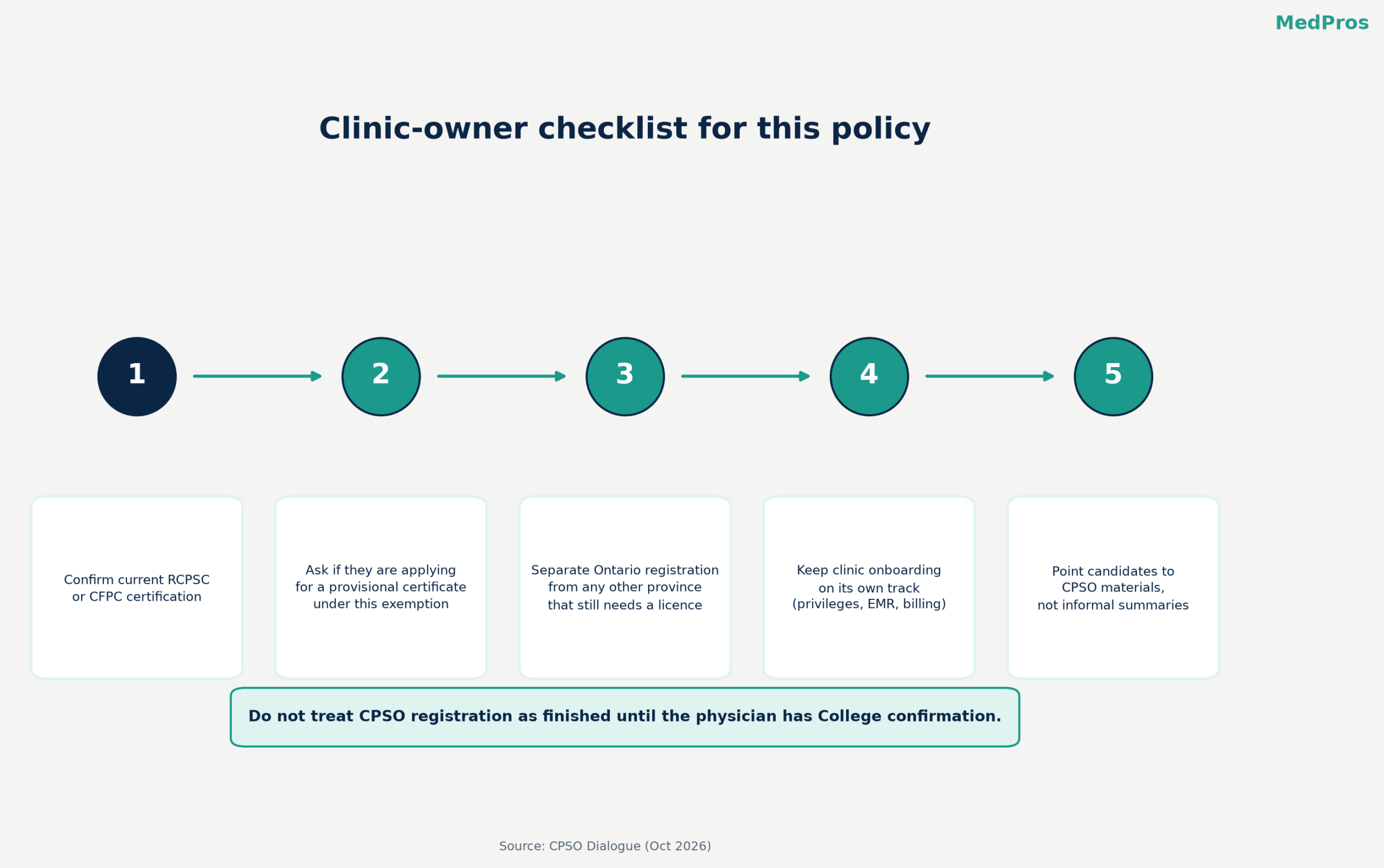
- Confirm they hold current RCPSC or CFPC certification (or that CPSO recognizes their certification under the applicable pathway).
- Ask whether they are applying for a provisional certificate under this exemption, and where they are in CPSO’s process.
- Separate Ontario registration from any other province where they still need a licence. The MCCQE or LMCC may still be required there.
- Keep clinic onboarding items on their own track: privileges, EMR access, billing setup, and orientation. Do not treat CPSO registration as finished until the physician has confirmation from the College.
- Point candidates to CPSO’s own materials rather than informal summaries. Policies and application details live with the regulator.
MedPros supports clinic setup and operations for more than 20 clinics across Ontario. We are not a licensing advisor. For registration questions, the physician should go directly to CPSO.
Soft next step
If you are planning recruitment into a new or expanding practice and want a clearer picture of clinic readiness around space, billing setup and launch timing, email info@medpros.ca.
Want our monthly MedPros Insider newsletter, or first word on new clinic, location and pharmacy opportunities? Email info@medpros.ca and ask to be added.
Sources
- CPSO Dialogue: New Policy Removes MCCQE and LMCC as Requirements for Registration (October 2026)
- CPSO Dialogue: Board Highlights, September 2026 (notes approval of the MCCQE/LMCC exemption policy for Canadian- and internationally-trained physicians)
This is general information for Ontario clinics and physicians, not legal, registration or medical advice. Confirm current CPSO registration requirements and your own application pathway directly with the College before relying on this summary.